

eSIMify

Best eSIM for United States

Cheapest United States eSIM plans from India — pay in ₹, instant QR delivery, no roaming fees.

14 standard plans

How long are you away?

Destination guide

Why use an eSIM in United States?

Nobody asks for your passport when you buy a SIM in the United States, which is the good news. The awkward part is where you buy it. AT&T, T-Mobile and Verizon prepaid SIMs are sold in Walmart, Target, Best Buy and carrier stores, none of which are in the arrivals hall at JFK, LAX or O'Hare, and the few airport vending machines charge a premium for the convenience. So the first hour in America is usually spent on airport Wi-Fi trying to summon an Uber without a working connection.

An eSIM for the United States is installed at home and connects when your phone first sees a US network on the taxiway. Your home SIM stays in for calls and bank OTPs with its roaming data off, and everything else, Uber and Lyft, Google Maps across a city grid you cannot walk, mobile boarding passes for the domestic hops, tap-to-pay and the group chat back home, runs on prepaid data. For a two-week road trip or a conference week, that beats a per-day roaming charge.
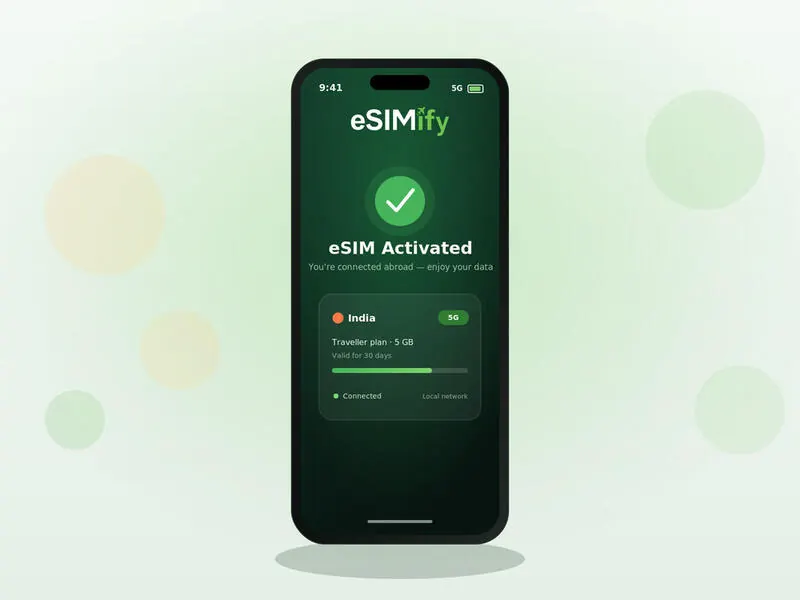
Best United States eSIM for tourists: what to look for

American trips tend to be long and to cover ground. A New York and Boston week, a West Coast loop from San Francisco to Los Angeles and Las Vegas, an Orlando family holiday, a Bay Area work stint of a month. Buy validity for the whole stay first, then data for how you travel: navigation across freeway systems, check-in emails, streaming on domestic flights and daily uploads all add up (see the plans above). A top-up queues behind the current plan if you run short.

5G is the norm in every big city on AT&T, T-Mobile and Verizon, and a 5G phone on the eSIM will use it without configuration. The more useful check is band support: some phones sold in India and elsewhere lack a few of the LTE and 5G bands the US carriers use, so look up your model on the device page before you buy. Hotspot is worth having for laptops on Amtrak; the plan card says whether it is included.

A US number is rarely necessary. Uber, Lyft and restaurant apps accept a foreign number, and contactless payment needs no SIM at all. Combined trips are common here: Niagara Falls from the Canadian side needs a Canada plan or a North America bundle, and Hawaii and Puerto Rico have their own pages, so check the plan card if they are on your route.

Networks and coverage: where your eSIM works

The United States has three national networks, AT&T, T-Mobile and Verizon, and every prepaid brand you see in a supermarket runs on one of them. All three offer 5G in the cities and along the interstates, and T-Mobile's mid-band 5G is the widest. The plan card names the partner network your eSIM uses; the phone selects the strongest signal on its own.

The country is large enough that gaps are a matter of geography rather than money. Yellowstone, the Grand Canyon rim trails, Death Valley, the Big Sur stretch of Highway 1 and long sections of interstate across Nevada, Utah and Wyoming have little or no signal, and Alaska outside Anchorage and the cruise ports is thin. In New York the subway stations have service but the tunnels between them mostly do not, so a call drops between stops. Domestic flights and Amtrak have no ground signal between cities; use their Wi-Fi.

  • New York: dense 5G across the five boroughs, subway stations included.
  • Los Angeles: strong from Santa Monica to Downtown, thinner in the canyons.
  • San Francisco: full coverage in the city and Silicon Valley, weak on the coast road south.
  • Chicago: reliable across the Loop and the L lines.
  • Las Vegas: excellent on the Strip, nothing on the desert roads to the parks.
  • Dallas and Houston: strong 5G across both metro areas.
  • Seattle: good in the city, patchy in the Cascades and the Olympic Peninsula.
  • Boston: full coverage, including on the T.
  • Orlando: solid across the theme parks and International Drive.
  • Washington DC, Miami and Honolulu: dense city coverage; Honolulu is on the Hawaii page.

United States eSIM vs local SIM vs roaming

Travel eSIM (eSIMify)Local SIMHome-carrier roaming
Setup: installed at home, live on the taxiway at JFK, LAX, SFO or ORD.A trip to a Walmart, Target or carrier store after you leave the airport.Nothing to do; your carrier bills by the day.
Cost pattern: one prepaid amount for the trip.Monthly prepaid plans are fair value for a month, poor value for a week.Daily rates that add up fast over a two-week trip.
Keep your home number: yes, for calls and OTPs.Only if a physical SIM slot is free.Yes.
Local number: no, data only.Yes, a US number.No.
Networks / speed: partner network 4G/5G, auto-selected.Full 5G on the carrier you chose, subject to your phone's bands.Whichever US network your carrier partners with.
Passport registration: none.None; the US does not register prepaid SIMs.None.
Best for: holidays, road trips and business visits of up to a month.Stays of several months, or anyone who needs a US number.An overnight connection or a one-day meeting.

For anything up to a month the eSIM is the practical choice: it works from the runway and the price is fixed. A local prepaid SIM is worth the store visit if you are staying for a semester or a long assignment and want a US number. Roaming makes sense only for the shortest business hop.

How to activate your United States eSIM

  1. Choose a United States plan above and pay; the eSIM is emailed to you within minutes.
  2. iPhone on iOS 17.4 or later: tap the direct install link in the email. Older iPhones: Settings, then Mobile Data, then Add eSIM, and scan the QR code.
  3. Android: Settings, then Connections or Network, then SIM manager, then Add eSIM; scan the QR code or type the SM-DP+ code.
  4. Label the line USA data.
  5. Turn on Data Roaming for the eSIM line and switch mobile data off on your home SIM, which stays in the phone for calls and OTPs.
  6. On landing, whether at JFK, Newark, LAX, SFO or O'Hare, select the eSIM as your data line; it usually connects before the aircraft reaches the gate.
  7. Validity starts at that first connection, not at purchase or install.

When should I install my United States eSIM?

Install the US eSIM on home Wi-Fi a few days before departure and leave it dormant; it costs nothing until it connects to an American network. Keep your home SIM as the data line during the flight and any connection in London, Frankfurt, Doha or Dubai, since the plan is for the United States only. Long-haul arrivals often land in the evening local time, so having the eSIM already installed means Uber is working while you wait for bags. If your itinerary starts in Canada or Mexico, switch the eSIM on when you cross into the US, not before.

Travel tips for United States

Keep your Jio, Airtel or Vi SIM in the phone with data roaming off; it still receives bank and UPI OTPs while the eSIM handles the data. WhatsApp calls work without restriction; the time difference is the only obstacle: the East Coast is nine and a half hours behind IST in summer and ten and a half in winter, and the West Coast is three hours further behind. UPI is not accepted; cards and phone wallets are used everywhere, including for tips.

Sockets are the flat two-pin Type A and B at 120 volts, so you need an adapter; phone chargers handle the voltage. Air India and United fly non-stop from Delhi and Mumbai to the New York area, San Francisco and Chicago. Indian food is easiest to find in Edison in New Jersey, Jackson Heights in Queens, Devon Avenue in Chicago, Artesia near Los Angeles, Hillcroft in Houston, and Sunnyvale and Fremont in the Bay Area.

Last verified 5 Sep 2026 · by eSIMify Editorial Team

United States eSIM by city

Travel connected

Why choose eSIMify for United States?

Instant activation

Connect the moment you land — no airport SIM kiosk.

Premium coverage

Auto-connect to the strongest local 5G/4G networks.

No roaming fees

Pay local prices — no surprise bills back home.

How it works

  1. 1

    Check compatibility

    Make sure your phone is eSIM-compatible and carrier-unlocked.

  2. 2

    Buy & receive

    Choose your plan and get a QR code by email instantly after payment.

  3. 3

    Scan & connect

    Scan the QR code in your phone settings and activate your data in seconds.

Activate your eSIM

Frequently asked questions

Yes in the stations, mostly no in the tunnels. Every underground station has mobile service, so maps and messages update at each stop, but the connection drops between stations on most lines. Above-ground sections in Brooklyn, Queens and the Bronx are fine.

Selected 1 GB · 3 days