


Best eSIM for Japan : Cheapest eSIM for Japan 2026
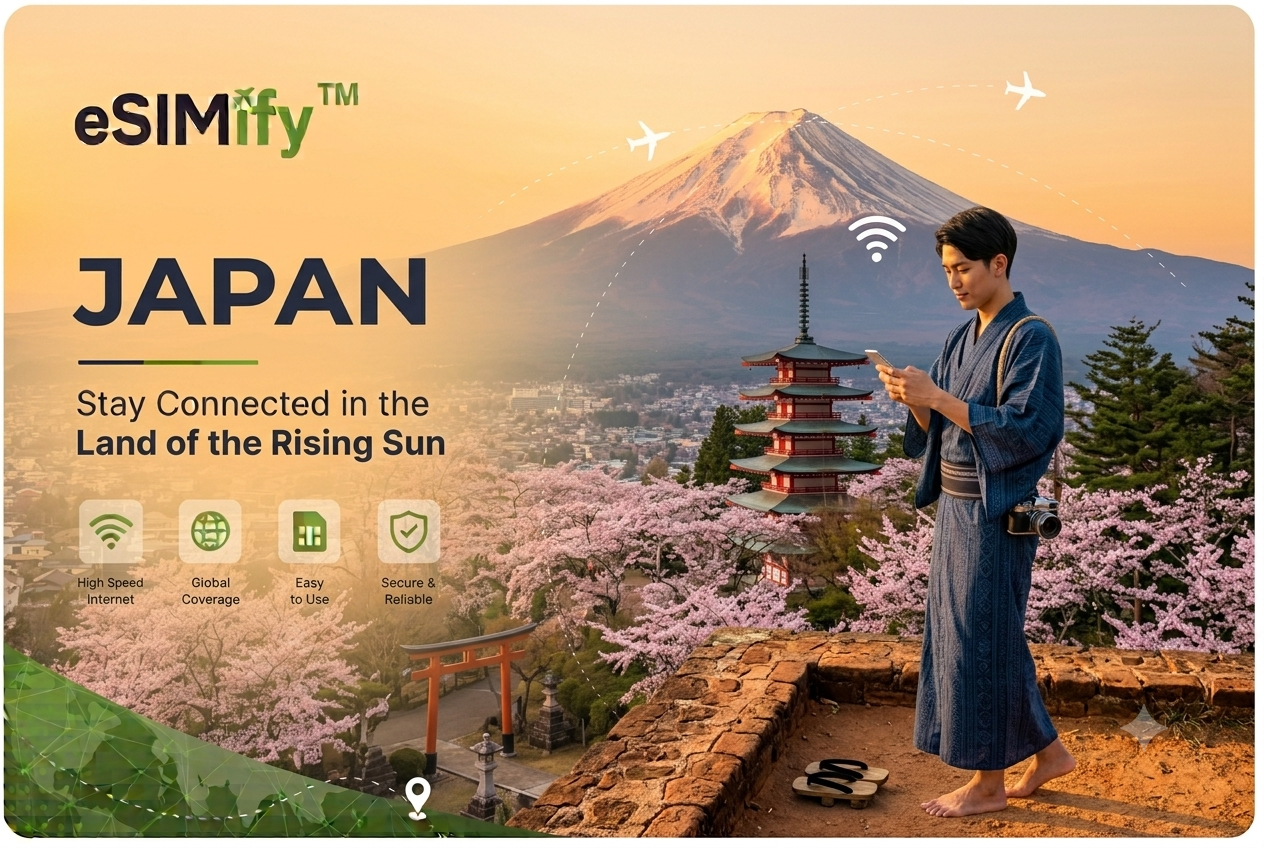
Japan is a country where being offline is genuinely difficult, not just inconvenient. Train transfers depend on live timings. Restaurant reservations run through apps. Your Suica card lives in your phone wallet. And Japanese addresses do not work the way addresses work anywhere else, so Google Maps is not optional. For years the default answer for visitors was renting a pocket WiFi device. In 2026, for most travellers, an eSIM is the better answer. Here is why, plus how to pick the best eSIM for Japan and how much data you will actually use.
Which networks will my eSIM use in Japan?
Japan's networks are NTT Docomo, SoftBank and KDDI au, and all three are outstanding. Coverage is close to total: full signal in Tokyo's deepest subway stations, along the entire Shinkansen route, in rural Hokkaido, on the Nakasendo trail, and at the top of the ropeway in Hakone. There are very few places in Japan where a modern travel eSIM will leave you without data.
Docomo generally has the deepest rural reach. In practice, on a standard Tokyo-Kyoto-Osaka itinerary, you will not notice the difference.
eSIM vs pocket WiFi in Japan: the honest comparison
Pocket WiFi was the standard for a decade and still has a following, so it is worth being straight about the trade-off.
Pocket WiFi advantages: one device connects several phones and laptops, so a family of four sharing one rental can work out cheaper per person. Battery life on the device means your phone battery lasts longer.
Pocket WiFi disadvantages: you have to collect it at the airport counter or arrange hotel delivery, carry a second device and its charger, keep it charged all day, and return it before you fly home. Lose it and you pay a replacement fee that is usually substantial. If two people in your group split up for the afternoon, only one of you has internet.
eSIM advantages: nothing to collect, nothing to return, nothing to lose, no second charger. Everyone in the group has their own connection. You are online the moment you land rather than after finding a counter in Narita.
The rule of thumb: solo travellers, couples, and anyone who might split up during the day should take an eSIM. A family of four or five who will be together all day and want to tether laptops might still find pocket WiFi economical — though a single unlimited eSIM with hotspot on covers most of that case now.
How much data do I need for a Japan trip?
- Light use: 500 MB to 1 GB a day.
- Typical tourist (Google Maps constantly, train apps, translation, photos, social): 1-2 GB a day.
- Heavy use, hotspot, or working: Unlimited.
A standard 10-day Tokyo-Hakone-Kyoto-Osaka trip usually lands around 10-15 GB. Japan pushes your usage up because you will run Google Translate's camera mode on menus and signage far more than you would elsewhere, and because you are checking train times all day.
The Japan-specific things that need live data
Suica or Pasmo in Apple Wallet: you can add a Suica card to your iPhone and top it up with your card, which is far easier than queuing at a machine. Adding and topping up requires an internet connection at that moment.
Google Maps transit: Japanese rail is a web of operators and Google Maps handles it beautifully, including which platform and which carriage to board for the fastest exit. This is the single most useful thing data does for you in Japan.
Restaurant bookings: many good restaurants take reservations only through Tabelog or their own site, and some require a Japanese phone number. Your eSIM does not give you a Japanese number, so plan bookings that accept email or a hotel-assisted reservation.
Translation: Google Translate's camera mode on a menu or a ticket machine is the thing that makes Japan easy. It works offline if you download the Japanese pack, and better online.
How to set up your Japan eSIM
- Check your phone is eSIM-compatible and carrier-unlocked.
- Buy your Japan eSIM on eSIMify. QR by email within seconds.
- Scan the QR before you fly. Validity starts on first connection in Japan.
- Land at Narita, Haneda or Kansai, enable data roaming for the eSIM line, and you are online.
Extra tip: download the Japanese offline language pack in Google Translate and offline maps for Tokyo, Kyoto and Osaka before you go. Both save data and both work when you are eight floors underground.
Why eSIMify works well for Indian travellers
Rupee pricing, UPI and RuPay payment, no forex markup, and India-timezone support. Japan is an expensive trip already — the connectivity part does not need to add to it.
Frequently asked questions
Does my Indian number still work in Japan?
Yes. Your Indian SIM stays active for calls and OTPs while the eSIM handles data. Keep data roaming off on the Indian line.
Do I get a Japanese phone number?
No. A travel eSIM provides data, not a local number. If a restaurant or service requires a Japanese number for booking, ask your hotel to make the reservation.
Will it work on the Shinkansen and in subways?
Yes. Japan has coverage along the entire Shinkansen route and in subway stations and tunnels, which is unusual and very welcome.
Is eSIM cheaper than pocket WiFi?
For one or two people, almost always. For a group of four or more travelling together all day, the maths gets closer — but an unlimited eSIM with hotspot usually still wins on convenience.
Can I add Suica to my phone with an eSIM?
Yes, provided your device supports it. Adding and topping up a Suica card needs an internet connection, which your eSIM provides.
Ready for Japan? Get your Japan eSIM in minutes — instant QR, no roaming bills.